Posts

HDMI (High-Definition Multimedia Interface)

Image
What is HDMI? HDMI (High-Definition Multimedia Interface) is the first industry-supported, uncompressed, all-digital audio/video interface. HDMI provides an interface between any audio/video source, such as a set-top box, DVD player, and A/V receiver and an audio and/or video monitor, such as a digital television (DTV). HDMI supports standard, enhanced, or high-definition video, plus multi-channel digital audio on a single cable. It transmits all ATSC HDTV standards and supports 8-channel digital audio, with bandwidth to spare to accommodate future enhancements and requirements. High Definition Multimedia Interface(HDMI) technology is the global standard for connecting HDTVs to home cinema equipment, PCs, Blu-ray players, and more. It combines uncompressed high-definition video, multi-channel surround audio, and intelligent system control data into a high-speed interface that provides crystal-clear digital quality over a single cable. As an HDMI Founder and principal architect of...
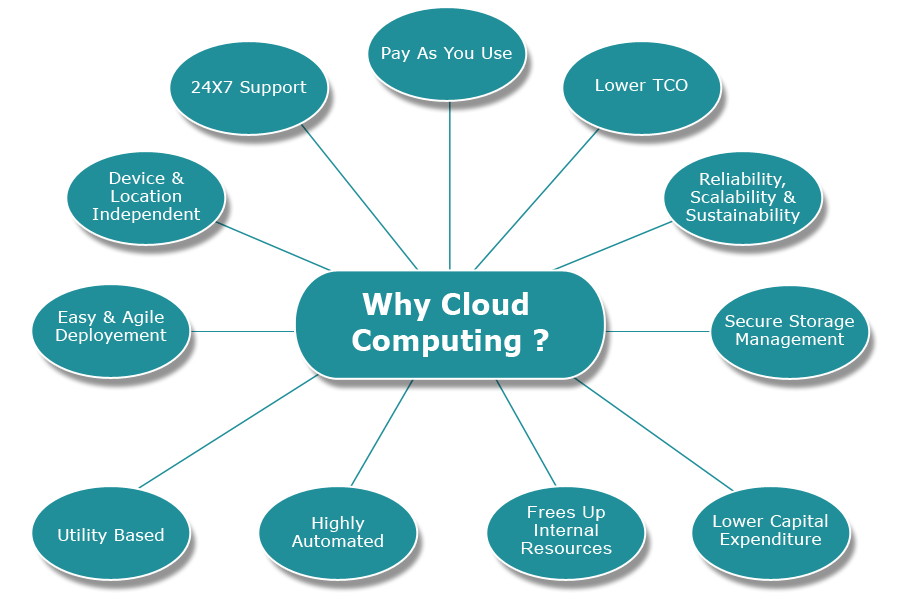
WHAT IS CLOUD COMPUTING???

Image
Let's say you're an executive at a large corporation. Your particular responsibilities include making sure that all of your employees have the right hardware and software they need to do their jobs. Buying   computers   for everyone isn't enough -- you also have to purchase software or   software licenses   to give employees the tools they require. Whenever you have a new hire, you have to buy more software or make sure your current software license allows another user. It's so stressful that you find it difficult to go to   sleep   on your huge pile of money every night. Soon, there may be an alternative for executives like you. Instead of installing a suite of software for each computer, you'd only have to load one application. That application would allow workers to log into a Web-based service which hosts all the programs the user would need for his or her job. Remote machines owned by another company would run everything from   e-mail ...

DLNA

Image
Digital home entertainment has come a long way in a fairly short time, and it's now easy to stream music, video and other media around the house without any hassle. Technologies such as DLNA (Digital Living Network Alliance) are a big part of that - so what is it, and where can you get it? Let's find out. DLNA is an organisation The Digital Living Network Alliance is a non-profit trade organisation, and it was started by Sony way back in 2003. The DLNA defines standards that enable devices to share stuff - photos, video, music - with each other, and it has more than 200 members responsible for more than 9,000 different DLNA devices. DLNA brings all your tech together DLNA is designed to act as a bridge between your various bits of kit, so you can watch a film from your PC on your big-screen TV, play an MP3 from your smartphone on your stereo, or send shots from the family photo album to your wireless printer via your tablet. Think of it as a kind of home cloud: it...

HOME AUTOMATION

Image
Imagine yourself sitting in your sofa with a remote in your hand, with which you can control your entire house or office sound too good to be true, doesn't it? But that has become possible today. Sitting at One place, you can control the whole house devices. One Click on the remote and you can change the lighting and ventilation of your house and also adjust the AC temperature settings. That's not all. You Can also play your favorite songs at the click of a button, without having to move anywhere.  

DOLBY ATMOS

Image
While traditional surround sound offers a high degree of audio realism to help pull the audience into the story, Dolby Atmos takes realism to a whole new level with its ability to place sounds at precise locations and move them anywhere in the theatre–even overhead. Here’s how Dolby Atmos compares to 5.1-channel and Dolby Surround 7.1 cinema sound, and the differences you can expect to hear.

2G vs 3G Network Technology

Image
2G and 3G technologies denote the second and third generation technologies used in wireless communication. In modern world increasing demand for communication has resulted in several standards for mobile communication. Among them 2G and 3G are dominant standards which revolutionize the mobile communication industry in past few years. Both standards emphasize on various targets and as a result various technologies have been introduced. 2G (GSM) Technology Global System for Mobile communication is also known as 2G which is the first step towards the digital wireless communication over existing analog mobile communication prevailing. Technology standard was first introduced in 1991 and from that onwards number of subscribers has grown over 200 million during 1998. In this technology for the first time SIM (Subscriber Identity Module) is introduced and a more secured and clear communication was established. This has been widely adopted all over the world and curren...
Image
What is GSM? Definition:  GSM, which stands for  G lobal  S ystem for  M obile communications, reigns as the world’s most widely used cell phone technology. Cell phones use a cell phone service carrier’s GSM network by searching for cell phone towers in the nearby area.  The origins of GSM can be traced back to 1982 when the Groupe Spécial Mobile (GSM) was created by the European Conference of Postal and Telecommunications Administrations (CEPT) for the purpose of designing a pan-European mobile technology.      What is CDMA? Definition:  CDMA, or  C ode  D ivision  M ultiple  A ccess, is a competing cell phone service technology to GSM, which is the world’s most widely used cell phone standard.  CDMA uses a “spread-spectrum” technique whereby electromagnetic energy is spread to allow for a signal with a wider bandwidth. This allows multiple people on multiple cell phones to be “multip...